Marilee Salvator grew up surrounded by nature. She spent much of her childhood outside exploring, wandering, and discovering the natural world, developing an early sense of wonder and connection to nature that continues to shape her life and work.

That fascination is still at the heart of Salvator’s practice. When she encounters an interesting material, she often wonders: Could I use this? Now an interdisciplinary artist, Salvator works across printmaking, sculpture, and immersive installation, allowing curiosity to lead her in unexpected directions.
Salvator earned her BFA from Illinois State University and her MFA from the University of New Mexico, both in Printmaking. She was drawn to printmaking because of its physicality and reliance on process. Repetition and accumulation have long been central to her work.
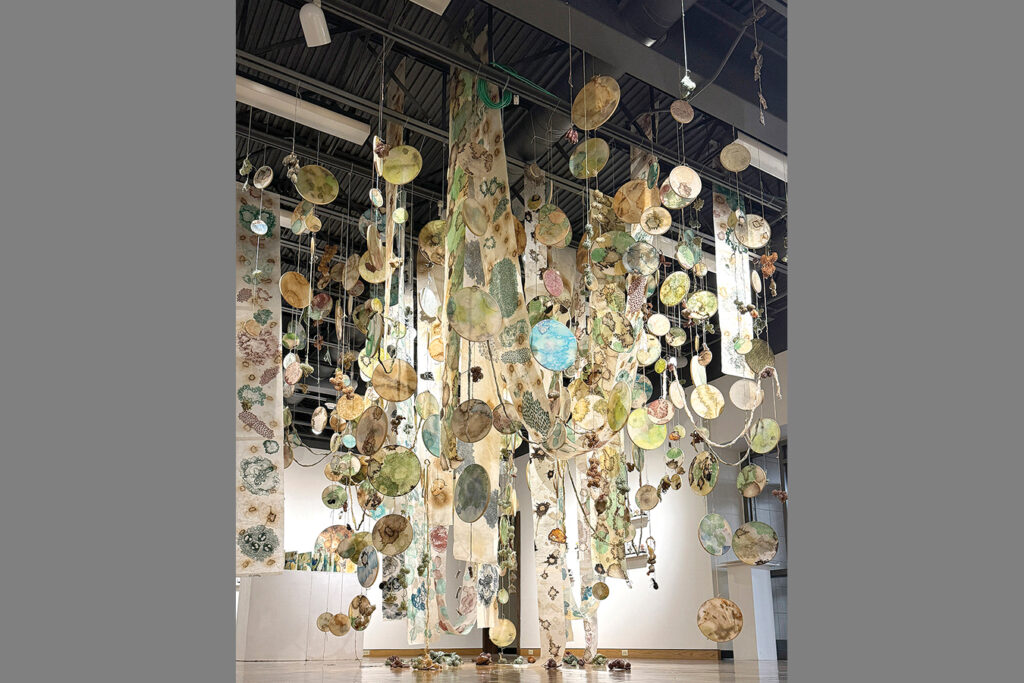
Over time, her prints began moving off the wall and into space. She started cutting, layering, suspending, and combining printed materials with natural materials. Printmaking became less about creating a single image on paper and more about building environments in which hundreds/thousands of individual parts accumulate into something larger, echoing the complexity of natural systems.

Much of Salvator’s work begins with looking closely. She is fascinated by things easily overlooked: microscopic structures, cellular forms, bacteria, the architecture of a seed pod, the intricate pattern of an insect wing, or the translucent shed left behind by a snake. Growth, decay, resilience, vulnerability, and interdependence recur throughout her work, as does a sense of awe at the ingenuity and strangeness of natural systems.
Science has become an important extension of this curiosity. Salvator has collaborated with scientists and used microscopic imagery and scientific research as starting points for prints and installations. Seeing organisms and structures at the microscopic level reveals another world of forms and relationships. For Salvator, art and science share something fundamental: curiosity, close observation, experimentation, and the excitement of discovering something you did not know was there.

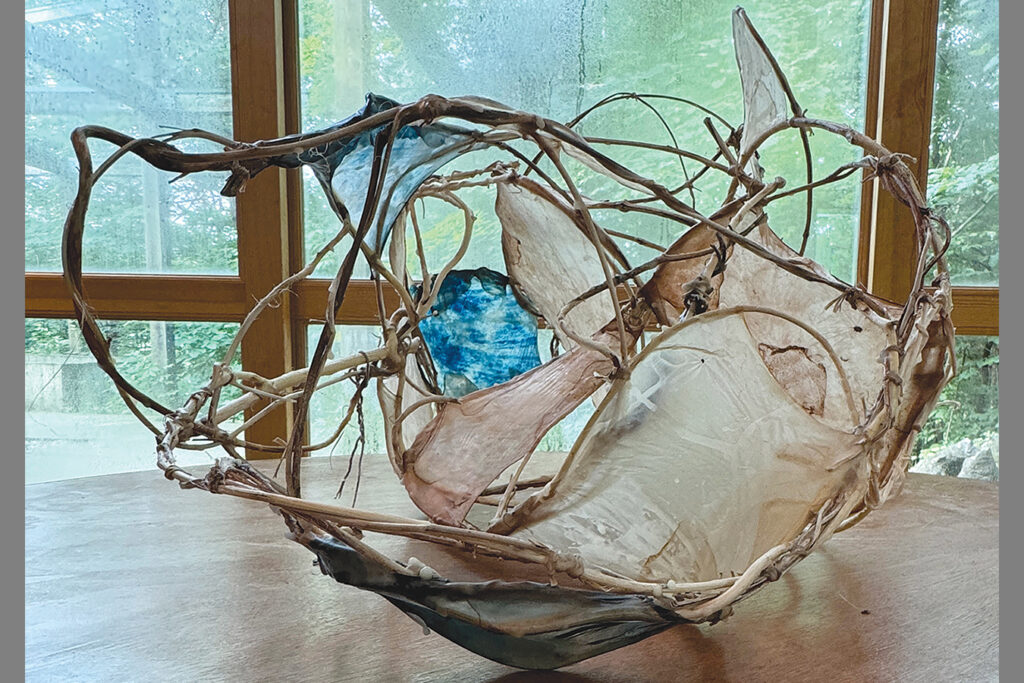
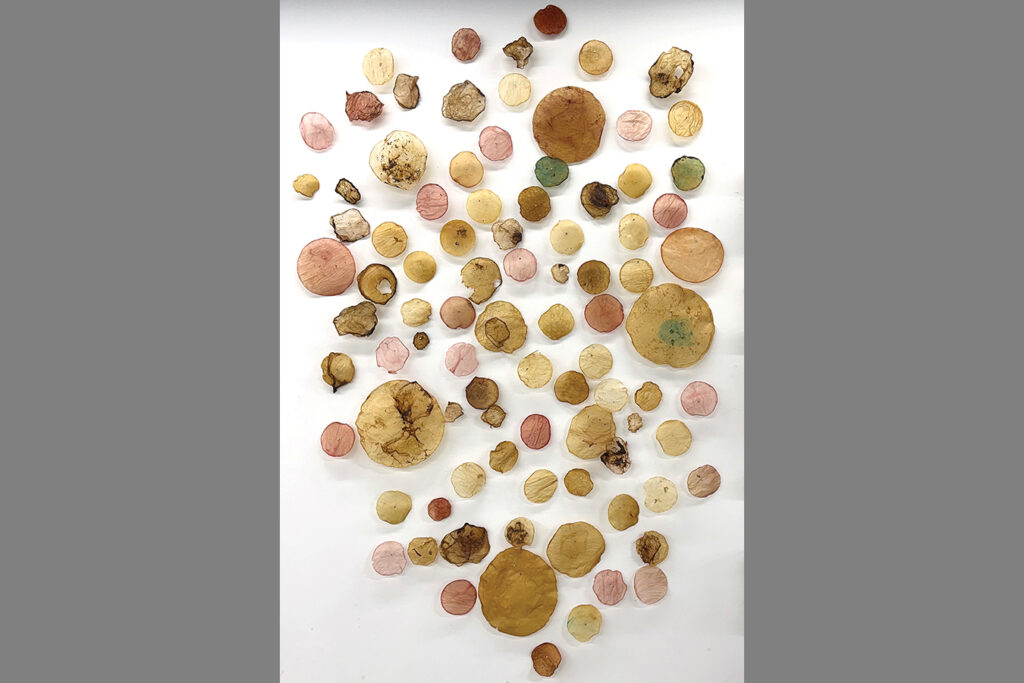
One of the unusual materials in Salvator’s current practice is kombucha SCOBY pellicles. She has brewed kombucha for more than twenty years and has always been fascinated by the strange, translucent pellicles that form during fermentation. As she watched them grow, she repeatedly wondered how she might use them in her artwork.
That curiosity led Salvator to begin growing SCOBY specifically for her artwork. Temperature, time, environment, and the shape of the vessel affect what develops. No two pellicles are alike. Salvator dries, stains, dyes, stitches, waxes, shapes, and suspends them, learning from how the material responds. Unexpected results often become the starting point for the next question.
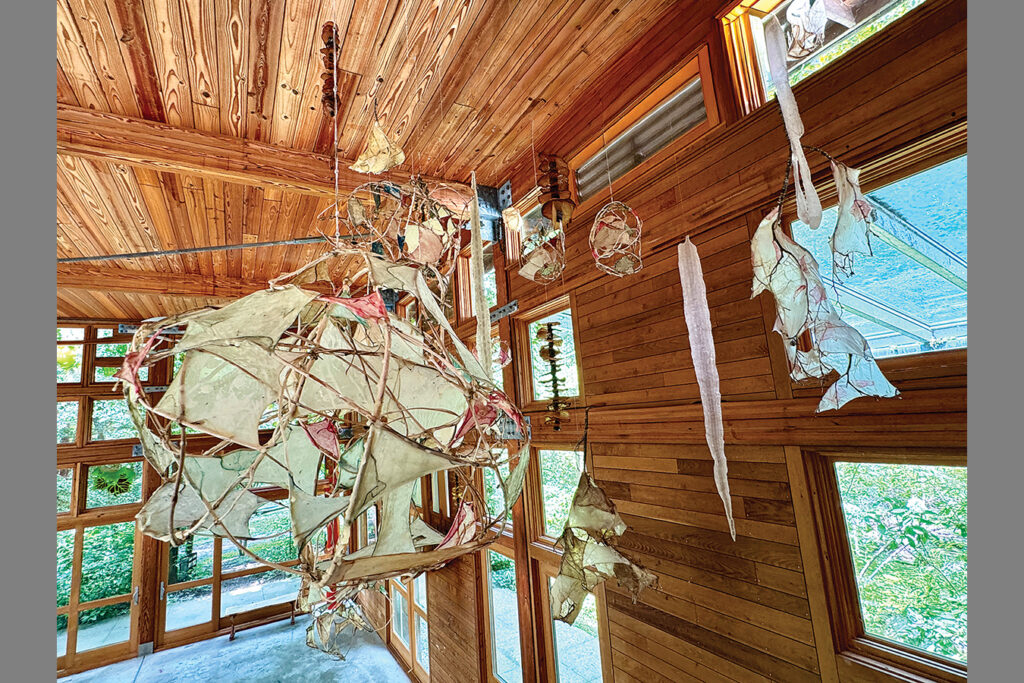
Her 2026 residency at Bernheim Arboretum and Research Forest gave Salvator an opportunity to take this approach into the landscape. During eight weeks at Bernheim, she explored the forest, collected fallen and invasive materials, observed ecological relationships, and developed work in response to what she encountered. The residency resulted in Interwoven, a large-scale immersive installation in Bernheim’s Visitor Center combining SCOBY pellicles, invasive honeysuckle vines, fallen branches, cyanotypes, natural dyes, beeswax, seed pods, snake sheds, and other materials.

Salvator continues to work with SCOBY pellicles while investigating snake sheds as an increasingly important material. She is captivated by their translucency, intricate patterning, extreme fragility, and what they represent. A snake leaving behind an almost perfect record of its exterior is both ordinary in nature and astonishing when examined closely. The discarded skin is not evidence of an ending, but of growth and transformation.
After many years of making art, Salvator remains fascinated by the seemingly endless things there are to discover. In many ways, the sense of wonder that began during a childhood spent exploring the natural world still drives her practice today. She continues to look closely, collect, experiment, and ask questions. Her work invites viewers to do the same, to notice the extraordinary complexity in things that might otherwise be overlooked and perhaps rediscover some of that wonder for themselves.
Salvator is a Professor of Art at Western Kentucky University. Her website is www.marileesalvator.com.
-submitted by the artist