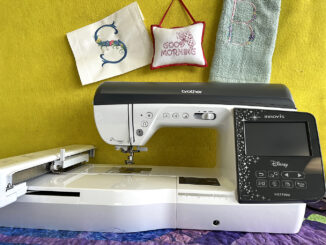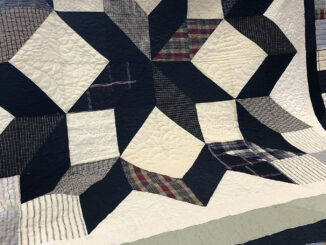
Appliqué is a very old and beautiful way to repair or accent garments, pillows, and quilts. For many centuries, appliqué was done by hand, but with the advent of the sewing machine, this decorative technique can be done quickly with beautiful results. Appliqué can be done with a regular sewing machine as well as with an embroidery machine. Both require a few notions to make the work a success.
Good appliqué begins, of course, with a good machine in working order. Appliqué can be done with a straight stitch only machine but most stitchers will benefit from having a machine with at least a zigzag stitch. Higher end machines will have several appliqué stitches to choose from.
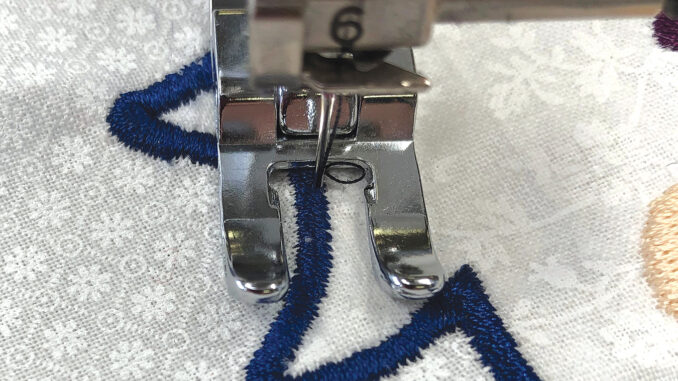
Other helpful supplies for appliqué include an open toe or appliqué foot for your machine. This foot is generally not included with your machine. The open toe foot allows you to clearly see the needle so your stitching, especially around corners, is very accurate. Stabilizer is needed to place behind the applique to keep the appliqué and garment from stretching or puckering. An iron-on tear-away is a good choice, especially if using your embroidery machine, OR a lightweight applique paper stabilizer works well.

Threads for appliqué can be varied. Regular sewing thread will work but machine embroidery thread is also a good choice for the color variety and sheen. Also, use machine embroidery bobbin thread in the bobbin as this will help to pull the top threads to the back to create a beautiful stitch. Needle size should be appropriate for the background fabric and it’s always a good idea to begin your project with a new one!
Some types of appliqué use adhesive products to secure the appliqué to the background fabric. The most popular two are paper-backed web adhesives and temporary spray baste adhesive. The paper-backed are the most popular and will remain in the project through many washings. Do make sure that you choose one that is sewable as a few of these are intended for non-sewing projects and the heavy glue will gum up your needle as you try to stitch. The spray adhesive will stay put for 12-24 hours and then dissipate. I like to use this on quilt projects as it doesn’t stiffen the finished project. You will need to spray and stitch within a few hours as the spray will lose its “sticky.”
Prepare your appliqué design by tracing it on the smooth/paper side of the paper-back fusible (reversing the design if needed). Trim around the design, leaving at least ¼” of paper beyond your design. Fuse the design to the wrong side of your fabric, following the manufacturers’ instructions. Trim away the excess paper and fabric, remove the paper and fuse design to your background fabric.
As with most sewing projects, always make a test sample of your stitching before beginning your project. You may need to adjust your stitch settings to get the “look” you are after and tensions may need to be slightly adjusted as well. Once you have your adjustments to your liking, make a note of them on your sample for future reference.
The most popular type of appliqué finish is the satin stitch. This is a zigzag stitch with a short stitch length that gives a rich, filled look to the stitch. You will need to experiment with your machine settings to get the look you want. Generally, the stitch width is 2-4mm and length is .3-.6mm.
Decorative stitches can also be used for appliqué with the blanket stitch being the most popular. The feather stitch and small star stitch found on many machines also work well.
Embroidery machines can also do appliqué in the hoop BUT you must have an embroidery file digitized for the design. If you have embroidery design software, you can create your own designs; otherwise, check to see what your machine has built-in or purchase your desired design. The machine will guide you through the appliqué steps which should include a placement outline, fabric stitch-down (fabric is placed in design area, stitched around and then you trim fabric to the stitching), and appliqué stitch. You will stabilize the design in the hoop as you would any other embroidery stitching.
Appliqué is a beautiful way to add an individual touch to sewing projects. Having the right supplies and right machine will help you achieve beautiful results!
-submitted by The Sewing & Vacuum Center