
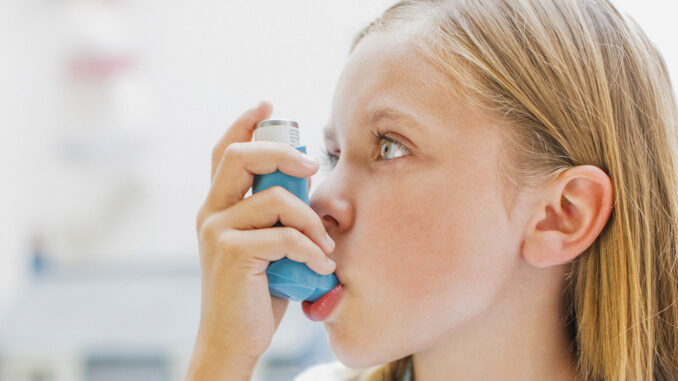
Asthma is the most common chronic medical condition of childhood. According to healthychildren.org, more than 26 million Americans have asthma. Over 25% of people with asthma are kids under 18 years old. Asthma is a chronic inflammatory disorder of the airway. In susceptible kids, this inflammation causes episodes of wheezing, breathlessness, a feeling of tightness in the chest, and coughing.
Children with asthma may take two classes of medications: controllers and relievers. The controller mediation is given daily to keep the asthma under control. Reliever medications are taken to relieve an acute asthma attack. Parents should make sure they bring their child’s reliever medication and delivery device (like an inhaler and spacer) with them to their dental visit.

According to the American Lung Association, children as young as three years old can use an inhaler with a spacer if they are shown how to do it and have supervised practice. Children who have trouble using inhalers may find a helpful to use a nebulizer. This is a small machine that converts the asthma medicine into a mist that the child can breathe in through a mask.
Several years ago, the Allergy and Asthma Network, an alliance of mothers of kids with asthma and allergies, celebrated that all 50 states, including Kentucky, protect students’ rights to carry and self-administer asthma medications at school. Older children that are comfortable using their inhaler can bring their inhaler with them to their dental appointment. Parents may need to check to make sure they have their younger child’s inhaler and spacer with them prior to their dental appointment.
According to a study in the Journal of the American Dental Association, asthma is not directly related to a higher risk for dental cavities. However, some kids with asthma experience a dryer mouth due to their nebulizer use. Parents should be aware of the increased risk of cavities in kids with dryer than normal mouths.
You can reduce your child’s risk of dental decay by seeing a dentist and coming up with a game plan to prevent cavities. The game plan will take into account your child’s risk factors for cavities and include things you can do to help prevent cavities. Sometimes it is as simple as extra brushing of your child’s teeth with fluoridated toothpaste at night after nebulizer use. There are also special rinses that can be used in kids with very dry mouths caused by their medications. These rinses coat the mouth and teeth and buffer the cavity-causing acid that is produced by the bacteria in the mouth.
In the dental office, the most concerning complication of asthma would be an acute asthma attack. That is why it is a good idea to bring your child’s inhaler and spacer along with you to their dental appointment. Many dental offices have an emergency albuterol inhaler, but few may have the spacer your young child needs to deliver the asthma medication properly. Also, make sure you tell your child’s dentist if there have been any recent asthma attacks and any Emergency Room visits. It is very helpful to know what triggers your child’s asthma and if they have ever had an attack during dental treatment.
The American Lung Association and the Center for Disease Control recommend that people with asthma have an emergency asthma attack plan. The Asthma Action Plan is developed between you and your child’s physician and provides specific instructions on early treatment of asthma symptoms. If your child has an Asthma Action Plan, it is a great idea to share this with your child’s dentist.
Rarely, some children with severe asthma experience adrenal suppression and this must be taken into account when planning extensive dental procedures. Your child’s dentist can work with you and your child’s physician to carefully manage even the most severely asthmatic child during dental treatment.
Special Considerations at the Dentist
•Make sure your child’s dentist has up-to-date information on your child’s asthma including medications, nebulizer use, recent asthma attacks, triggers for the attacks and any hospitalizations or complications.
•Bring your child’s inhaler with you to their dental appointment. If your child uses a spacer with their inhaler, bring that, too.
•Share your child’s Asthma Action Plan with your child’s dentist. If you do not have an Action Plan, consider talking with your child’s doctor and developing a written plan.
-by Dr. Mandy Ashley
About Our Dentists: Dr. Mandy Ashley and Dr. Madison Galloway are Board Certified Pediatric Dentists proud to serve the communities of Bowling Green, Hopkinsville, and Glasgow! We look forward to sharing our vision of excellent comprehensive dental care that is fun for children and people with special healthcare needs with your family.
SKY Pediatric Dentistry has been providing dental care to children and adults with special needs since 2013. As board-certified specialists in dentistry for children, our team strives to make going to the dentist as fun as possible while maintaining high-quality treatment and preventative measures. We tailor treatment plans to each child and offer a wide range of treatment options, including sedation, in-office general anesthesia, and also hospital-based dentistry. With over 25 YEARS of doctor experience, SKY Pediatric Dentistry is a great choice for children’s dental care in Bowling Green, Hopkinsville, and Glasgow!