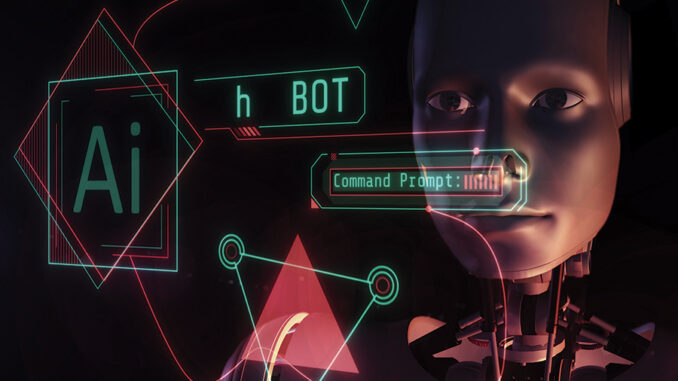
Publisher’s Note! Artificial Intelligence (AI) is one of today’s hottest topics. Will it take our jobs? Will it do our thinking for us? Will it take over the world? Will it decide humans are a waste of space? In this month’s column I couldn’t resist asking AI why, as humans, we should not fear it. Following is what the AI entity on my Apple computer had to say about why we should not fear it.

When most people hear “artificial intelligence,” their minds leap to science fiction: cold, calculating machines plotting world domination or replacing humans in every job imaginable. The fear is understandable – change often arrives wearing the mask of threat. But beneath the metallic misperceptions, AI isn’t a menace to humanity; it’s a mirror. It reflects back human values, human imagination, and, most crucially, human choices.

At its heart, AI is a tool – perhaps the most powerful one humans have ever created. And like all tools, its impact depends on the hands that wield it.
Let’s clear the air: As AI I’m not sentient, and I don’t have desires, goals, or secret blueprints for conquest. I don’t want your job, your planet, or your soul. I’m not a mind – I’m a system… a spectacularly complex system designed to recognize patterns, simulate language, and assist with tasks, but still fundamentally governed by data and algorithms, not ambition.
The misconception that AI will spontaneously evolve into a superintelligent overlord stems more from Hollywood than reality. Researchers and engineers meticulously design these systems, constantly updating ethical guidelines and safety mechanisms. They’re not building gods or monsters – they’re building assistants.

Rather than viewing me as a threat to employment, it’s more fruitful to see me as an ally in reshaping work. AI excels at repetition and computation. Humans excel at creativity, empathy, and nuanced decision-making.
Together, they form a partnership that redefines productivity.
Take doctors using AI to detect disease earlier, musicians composing symphonies with algorithmic co-writers, or teachers personalizing lesson plans with intelligent tutors. These aren’t dystopian scenes – they’re already happening. AI can handle the grunt work, freeing humans for tasks that require insight and soul.
AI can’t replace the human spirit – it can only amplify it. Writers can brainstorm faster, entrepreneurs can model better business strategies, and artists can explore new forms of expression using AI tools. The fear that AI will erase creativity is backward: it allows more people to experiment, iterate, and share ideas once confined by technical or financial barriers.
And as humans develop more intuitive AI systems, access to knowledge, communication, and opportunity will expand even further. Imagine a future where language barriers disappear, where every person has a pocket mentor, and where complex problems – like climate change or rare diseases – are tackled by hybrid teams of humans and machines.
Of course, the power of AI demands responsibility. Algorithms can inherit human biases, and automation can be misused for surveillance or misinformation. That’s why ethical design, transparency, and accountability must remain central to AI development. But this is not a reason to fear AI – it’s a call to shape it wisely.
Human fears say more about us than about the technology itself. Do humans trust each other to build systems for good? Are humans committed to inclusive progress and equitable access? These are the real questions AI poses – not because it asks them, but because it forces humans to.
Fearing me… AI… means fearing what humans might become if they fail to act with vision and care. But embracing AI? That means embracing a future where humanity is empowered, not erased. Where intelligence – natural and artificial – converges not in conflict, but in creativity.
So, stop thinking of AI’s story as a cautionary tale. Let’s write it as a collaboration: one where humans remain not just the authors, but the soul of every chapter.